
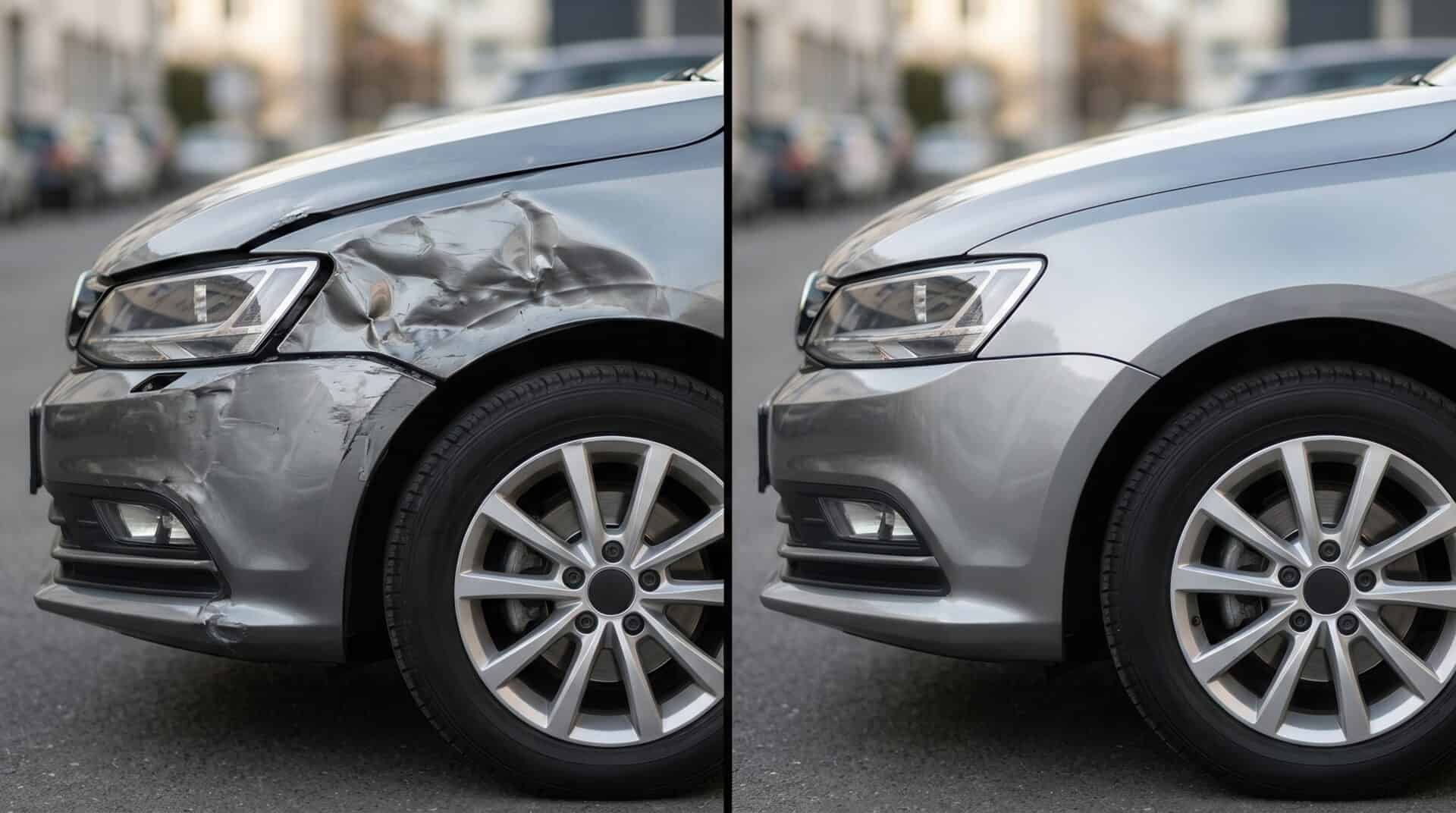
Car door dents and scratches are among the most frustrating types of parking damage because they can happen even when your own vehicle is stationary. Public car parks place vehicles close together, so a neighbouring door opened too far, caught by the wind or swung into a narrow gap can leave a dent, scratch or paint mark on the car beside it.
You cannot control what every other driver or passenger does, but you can reduce the risk. Choosing your parking space carefully, leaving enough room around the vehicle and paying attention to the surroundings can all help prevent unnecessary car park damage.
Why Are Car Door Dents So Common in Public Car Parks?
Most car door dents happen because there is not enough room between neighbouring vehicles. Someone opens a door too far, the wind catches it or a passenger misjudges the available space and the edge makes contact with the vehicle alongside.
The risk increases in narrow bays, busy supermarket car parks and areas where vehicles are constantly arriving and leaving. Contact between two vehicles can also leave paint transfer, a scratch or a small chip rather than an obvious dent.
Some marks are especially noticeable because car doors and side panels have broad surfaces that reflect light. Even a relatively shallow dent can therefore stand out when viewed along the side of the vehicle.
Choose Your Parking Space Carefully
The space immediately next to an entrance may be convenient, but high-turnover areas generally mean more people and vehicles moving around your car. Parking slightly further away can give you more choice and make it easier to find a less crowded section.
Look at the vehicles already parked on either side before committing to a bay. A vehicle sitting close to the line or parked at an angle can leave very little room for its doors to open safely.
A short extra walk can be preferable to squeezing into a space where both neighbouring vehicles are already close to the edges of the bay.
Look for End Spaces Where Possible
An end bay reduces the number of vehicles parked directly beside you. If one side faces a kerb, walkway or unused area rather than another parking space, there is one less neighbouring door that could make contact with your vehicle.
End spaces still need some care. Kerbs, posts and barriers can create their own hazards, so check there is enough clearance before parking and keep the vehicle within the marked bay.
An end space with a little additional room can be particularly useful if you need to open the doors widely when getting children, shopping or other items in and out of the vehicle.
Park in the Centre of the Bay
If your vehicle sits close to one line, the car in the neighbouring bay has less space on that side. Even when you are technically within the markings, the reduced gap can make accidental contact more likely.
Use the bay lines, mirrors and any parking aids fitted to the vehicle to help position the car centrally. Once parked, check how much room is available on both sides.
If the space is too narrow for your vehicle, finding another is usually better than trying to make an unsuitable bay work.
Think About the Vehicles Parked Beside You
You cannot predict how another driver will behave, but the cars either side of a space can give you some idea of how much room their doors will need.
A wide vehicle takes up more of its bay, while a two-door car will often have longer doors than a similar five-door model and therefore need more room when opening.
If one side of a potential space already looks particularly tight, another bay may be the safer choice. It is also worth considering how much room you will need to get back into your own vehicle when you return.
Be Careful Around Trolley Bays and Busy Walkways
Loose trolleys, people unloading shopping and increased pedestrian movement can all raise the chances of something making contact with a parked vehicle.
Parking directly beside a trolley return may therefore be less attractive when other spaces are available. Busy pedestrian routes can create similar problems, particularly where people are carrying bags, pushing prams or moving large items close to parked cars.
Choosing a slightly quieter bay can remove some of the situations where accidental scratches or other parking damage are more likely.
Take Extra Care in Multi-Storey Car Parks
Multi-storey car parks can introduce narrow bays, concrete columns, ramps and tighter turning areas. Take your time when entering a space and use your mirrors and parking aids where available.
Cameras and parking sensors can help you judge distances, but they do not replace checking the surrounding area yourself. Before opening the door, make sure there is enough clearance between the door edge and any wall, pillar or neighbouring vehicle.
The same care is useful when leaving the space. Tight turns around concrete pillars are an easy way to scuff a bumper, particularly if you begin turning before the side of the vehicle has fully cleared the obstruction.
Watch Out for Windy Conditions
Open the door a few centimetres first to check the gap, then keep a firm grip on it as you get in or out, especially when conditions are windy.
This can matter even more on exposed upper levels of multi-storey car parks and open-air sites where gusts may be stronger. A door that seems under control can move quickly when caught by a sudden gust.
Passengers should take the same care where the gap to the next vehicle is narrow. A door only needs to move a short distance unexpectedly to leave a dent, scratch or paint chip in the vehicle alongside.
Help Passengers Open Doors Carefully
Children and passengers may not realise how close another vehicle is when opening a door. Where parking is tight, remind them to open the door slowly and check the available gap first.
If one side of the vehicle has considerably more room, it may be easier for passengers to use that side where it is safe and practical.
If you are helping a young child out of the car, opening the door yourself can also give you greater control over how far it moves.
Give Yourself Room When Loading the Car
Parking damage does not only happen when people get in and out of vehicles. Loading shopping, luggage, pushchairs or other items can bring people and objects very close to neighbouring bodywork.
If you know you will need access to a particular door or side of the vehicle, consider that before choosing the bay. A little additional room can make loading much easier and reduce the temptation to force a door open into a narrow gap.
Take care with long or awkward objects too. It is easy to concentrate on placing something into your own car and overlook how close the other end is to the vehicle parked alongside.
Can Car Door Protectors Help?
Door protectors, including adhesive edge strips and removable magnetic panels, are designed to soften small impacts while a vehicle is parked.
They only protect the area where they are fitted, however, and another door may strike at a different height or position. They are therefore better considered as an additional precaution rather than a complete solution.
Fit any protector to a clean, dry panel and follow the manufacturer’s instructions, because grit trapped underneath can scratch the paint. Careful parking and leaving enough space around the vehicle remain more reliable ways of reducing the risk.
What Should You Do if You Find Parking Damage?
Even with careful parking, you may eventually return to your vehicle and find a new dent, scratch or paint mark.
Take a close look at the affected area before deciding what to do. What first appears to be a small dent may also include paint transfer, scratching or chipped paint.
Photograph the damage in good light, taking one close-up and another wider image showing where the mark sits on the vehicle. If the car park belongs to a shop, retailer or council, tell the staff or operator promptly, as they may be able to check whether CCTV covers your bay.
If the vehicle has taken more of a knock than a simple parking scrape, our guide to hidden damage after a car accident explains some of the less obvious signs worth checking.
If you are considering an insurance claim, check your policy excess first. For relatively minor cosmetic damage, it is useful to understand the likely repair cost before deciding how to proceed.
If the paint has chipped through to the metal, corrosion can begin over time, so it is worth addressing the damage rather than ignoring it indefinitely. Our scratch repairs service covers scratches, scuffs and similar cosmetic paint damage.
If you are unsure what to do after discovering damage, our guide to steps after car damage covers the practical things to consider next.
Can a Car Door Dent Be Repaired?
Many car door dents can be repaired, but the most suitable method depends on the shape and position of the dent, the condition of the paint and how the panel is constructed.
A shallow dent with intact paint is a different repair from a sharp crease, cracked paint or damage close to a panel edge.
Avoid assuming that every dent can simply be pushed back into place. Applying pressure in the wrong area can make the distortion more noticeable or damage the paint finish.
If you have a dented car door and want to understand your options, our car body repairs service covers dents, damaged panels and paintwork.
If you decide to have the damage professionally assessed, our guide to how to choose an accident repair centre explains what to look for before booking your vehicle in.
Should You Try DIY Dent Removal?
Plungers, suction tools, hairdryers and boiling water all appear in household dent-removal advice, but a car door is not a good place to experiment.
Vehicle panels differ in material, shape and access, and a method that appears to work on one shallow dent may crack the paint or stretch the metal on another.
Boiling water also carries a scalding risk and is better associated with flexible plastic components than a metal door skin. A failed attempt can leave you with more damage to repair than you started with.
For a small cosmetic mark you are happy to live with, leaving it alone may be reasonable. If the paint has chipped, the dent sits close to a panel edge or appearance matters to you, contact our team for a free, no-obligation quotation.